
Best Cable TV and Internet Packages: 2026 Provider Guide
Finding the best cable tv and internet packages requires looking past promotional price tags to evaluate overall channel lineups, download speeds, and hidden monthly equipment fees. Modern telecom providers offer a mix of traditional coaxial bundles and high-speed fiber connections paired with live TV streaming options. Comparing nationwide providers like Xfinity, Spectrum, Optimum, and Verizon Fios helps households balance broadband speeds, regional sports coverage, and long-term pricing guarantees.
Quick Answer: The best cable TV and internet packages balance high-speed broadband (300 Mbps to 1 Gbps) with diverse channel packages at a predictable monthly rate. Xfinity leads in customizable options and nationwide availability, Spectrum excels with no-contract plans, and Optimum or Verizon Fios deliver top value where fiber infrastructure is present. For total price transparency, always calculate additional regional sports fees and box rentals before signing a contract.
Trust and Editorial Methodology
This evaluation of the best cable tv and internet packages is maintained by an independent telecommunications research team. Analysis is based on direct evaluation of published carrier rate disclosures, Federal Communications Commission (FCC) broadband label data, and service availability matrices as of late 2026. Pricing and features represent standardized national metrics; regional plan pricing may vary based on localized infrastructure and municipal franchise agreements.
Table of Contents
Understanding Modern Cable TV and Internet Packages
Evaluating the best cable tv and internet packages involves understanding how telecommunications providers bundle high-speed broadband internet with television entertainment. Modern bundles range from traditional double-play coaxial cable options to high-bandwidth fiber optic connections paired with digital TV apps. Assessing total cost requires examining base service rates alongside required hardware fees, regional sports surcharges, and promotional expiration dates.
Core Evaluation Criteria for Home Bundles
To determine overall value when selecting a double-play package, evaluate four primary structural elements:
- Broadband Bandwidth: Ensure download speeds match your home’s requirements, ranging from 300 Mbps for everyday streaming and remote work to 1,000 Mbps (1 Gbps) or higher for multi-device households and online gaming.
- Channel Selection and Local Networks: Verify that the channel lineup includes essential local broadcast affiliates (ABC, CBS, FOX, NBC) alongside preferred regional sports networks (RSNs) and cable news outlets.
- Hardware and Equipment Requirements: Account for set-top box rentals ($10–$18/month per TV), Wi-Fi router lease fees ($10–$15/month), and Cloud DVR storage upgrades.
- Contract Commitments and Price Stability: Distinguish between no-contract providers offering month-to-month flexibility and providers offering 1- to 3-year price locks in exchange for term agreements.
When reviewing providers, solutions like Xtreme HD IPTV showcase how modern digital entertainment distribution operates alongside standard home broadband networks.
Traditional Cable vs. Fiber and Live TV Streaming
The telecommunications market currently offers two primary delivery methods for home entertainment and connectivity:
- Traditional Coaxial Bundles: Delivered over hybrid fiber-coaxial (HFC) networks by providers like Comcast Xfinity, Spectrum, and Cox. These plans deliver fast download speeds and traditional channel guide navigation through dedicated hardware set-top boxes.
- Fiber Internet + Live Streaming (Cord-Building): Delivered over 100% fiber-optic lines by providers such as Verizon Fios, AT&T Fiber, or Frontier. Instead of a legacy cable box, TV service is delivered over high-speed Wi-Fi using live streaming applications or over-the-top (OTT) TV bundles.
+-----------------------------------------------------------------------------------+
|                        CHOOSING YOUR CONNECTIVITY ARCHITECTURE                    |
+-----------------------------------------------------------------------------------+
                                          |
        +---------------------------------+---------------------------------+
        |                                                                   |
        v                                                                   v
[ Traditional Coaxial Cable ]                                  [ Fiber Internet + OTT Streaming ]
  - Single provider billing                                      - Symmetrical upload & download
  - Hardware box required ($10-$18/mo)                           - No mandatory set-top box fees
  - Established channel numbering                                - Higher reliability, lower latency
  - Subject to Regional Sports Fees                              - Stream on Smart TVs & devices
Top Cable TV and Internet Bundles for 2026
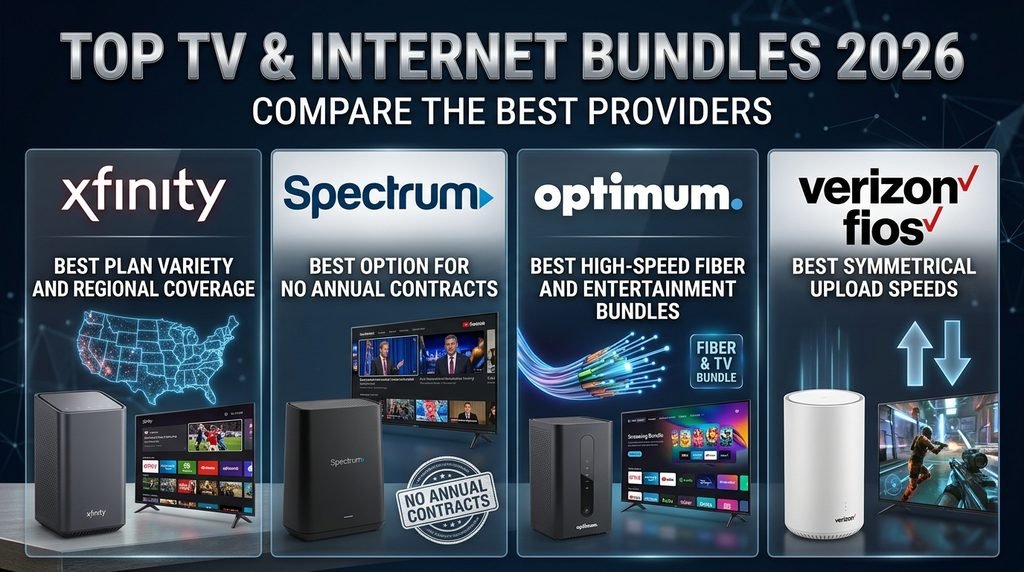
Major telecommunications providers offer distinct packaging strategies tailored to regional availability, internet speeds, and channel diversity.
Xfinity: Best Plan Variety and Regional Coverage
Comcast Xfinity offers widespread availability across the United States, providing highly customizable combinations of cable internet and television plans.
- Internet Speeds: Ranging from 300 Mbps to 2,000 Mbps.
- TV Packages: Tiered options starting at TV Core (10+ local channels) up to TV Ultimate (185+ channels including sports and entertainment).
- Key Strengths: Features the award-winning X1 voice remote control, integrated streaming apps, and high-capacity Cloud DVR storage.
- Considerations: Regional sports network fees and broadcast television surcharges can add $20–$35 per month above the base package price.
Spectrum: Best Option for No Annual Contracts
Spectrum provides simple plan structures without requiring long-term service contracts or early termination penalties.
- Internet Speeds: Starting at 300 Mbps or 500 Mbps, with Gigabit plans available nationwide.
- TV Packages: Spectrum TV Select Signature (150+ channels) and Stream TV options designed for app-based viewing on hardware like the Xumo Stream Box.
- Key Strengths: No annual contracts, transparent contract buyout programs up to $500 for new customers, and optional equipment opt-out savings for personal Wi-Fi routers.
- Considerations: Broadcast TV fees still apply to traditional cable lineups, though contract-free flexibility helps manage long-term commitments.
Optimum: Best High-Speed Fiber and Entertainment Bundles
Optimum operates across major East Coast and central markets, offering both traditional coaxial cable and 100% fiber-optic network connections.
- Internet Speeds: Options range from 300 Mbps to 1,000 Mbps (1 Gig) and up to 8,000 Mbps in fiber-ready zones.
- TV Packages: Entertainment TV (70+ channels), Extra TV (120+ channels), and Everything TV (200+ channels).
- Key Strengths: Competitive introductory pricing, multi-year price-lock options on select plans, and included Wi-Fi gateway hardware on fiber tiers.
- Considerations: Promotional rates jump significantly after the initial 12- to 36-month period depending on regional availability.
Verizon Fios & Fiber Alternatives: Best Symmetrical Upload Speeds
Verizon Fios utilizes a 100% fiber-optic network to deliver matching download and upload speeds, ideal for remote work, large file transfers, and modern smart home connectivity.
- Internet Speeds: 300 Mbps, 500 Mbps, and 1 Gig symmetrical tiers.
- TV Packages: “Your Fios TV” personalized selections (125+ channels) up to “The Most Fios TV” (425+ channels).
- Key Strengths: Fiber-optic reliability, zero annual contract requirements, no separate broadcast surcharge line-items on standard internet-only plans, and high picture fidelity.
- Considerations: Geographic availability is limited primarily to the Mid-Atlantic and Northeastern United States.
Comparing the Best Cable TV and Internet Packages
To evaluate the best cable tv and internet packages, the following decision matrix outlines representative national plans, average broadband speeds, base channel counts, and estimated monthly pricing based on published carrier documentation.
National Provider Feature & Pricing Comparison
| Provider | Representative Package Tier | Max Download Speed | Included Channels | Estimated Starting Price (Mo.) | Key Package Highlight |
| Xfinity | Internet 300 + TV Plus | 300 Mbps | 125+ Channels | $135.00/mo. | Advanced X1 Voice Remote & App Integration |
| Spectrum | Internet 500 + Stream TV Signature | 500 Mbps | 150+ Channels | $130.00/mo. | No Annual Contract & $0 Contract Buyout Program |
| Optimum | 1 Gig Fiber + Entertainment TV | 940–1,000 Mbps | 80+ Channels | $85.00/mo. | Low Entry Pricing & Included Wi-Fi Equipment |
| Verizon Fios | Fios 500 Mbps + Your Fios TV | 500 Mbps | 125+ Channels | $159.99/mo. | 100% Symmetrical Upload/Download Fiber Network |
| Frontier + OTT | Fiber 500 + Live Streaming Partner | 500 Mbps | 100+ Channels | $112.98/mo. | Unlimited Cloud DVR & Pure Fiber Broadband |
Note: Data compiled from publicly available provider rate cards as of late 2026. Prices reflect initial promotional tiers with AutoPay enabled and exclude regional taxes, broadcast surcharges ($15–$25/mo), and local regulatory fees.
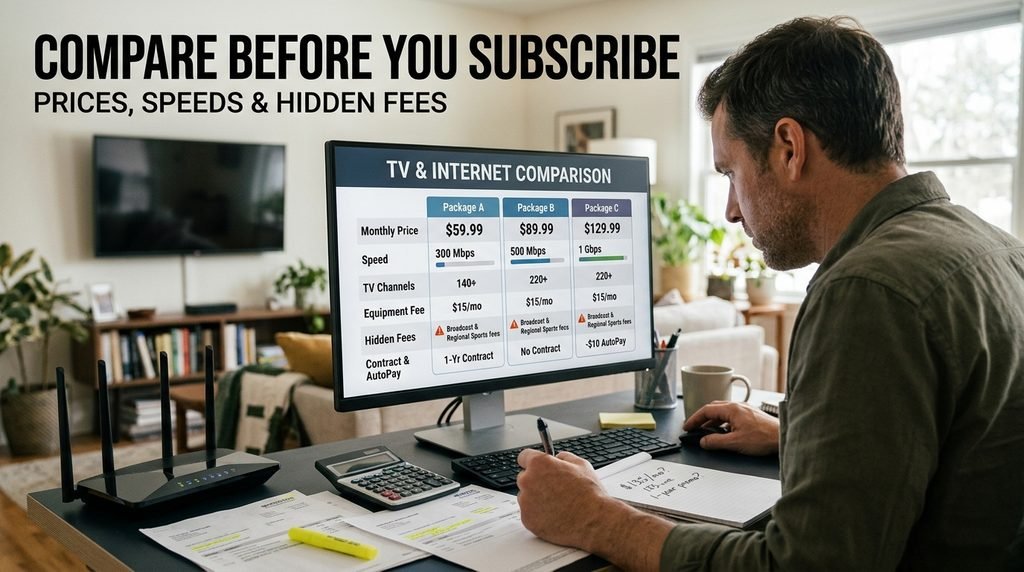
Identifying Hidden Fees: Regional Sports, Hardware, and AutoPay
Understanding the total cost on your monthly invoice requires accounting for line-item surcharges that sit outside advertised package prices:
- Broadcast TV Surcharges: Fees levied by cable operators to pass along local network licensing costs, typically adding $15 to $25 per month.
- Regional Sports Network (RSN) Fees: Mandatory fees for packages containing regional sports channels (e.g., Bally Sports, YES Network, NESN), adding $8 to $18 per month.
- Set-Top Box and Modem Rentals: Monthly leasing costs for cable receivers ($10–$18/box) and Wi-Fi gateways ($10–$15/month).
- AutoPay and Paperless Discount Requirements: Most advertised rates assume a $5 to $10 monthly discount applied only when linking an active bank account or debit card for recurring billing.
How to Choose the Right Bundle for Your Household
Selecting the ideal service plan requires aligning bandwidth capacity with your home’s daily online activities and choosing an acceptable balance of contract stability versus billing flexibility.
                              +---------------------------------+
                              |   EVALUATE HOUSEHOLD BANDWIDTH  |
                              +---------------------------------+
                                               |
                  +----------------------------+----------------------------+
                  |                                                         |
                  v                                                         v
          [ 1-3 Heavy Users ]                                      [ 4+ Power Users / Smart Home ]
          - 300 - 500 Mbps Download                                - 1,000 Mbps (1 Gig) Symmetrical
          - HD Streaming & Light Gaming                            - 4K Multi-Screen Streaming & Uploads
          - Standard Entertainment TV Tier                         - Expanded Sports & Premium Channel Tier
Matching Download Speeds to Household Usage
Selecting excess bandwidth increases monthly costs unnecessarily, while underestimating speed leads to network congestion during peak hours. Use these guidelines to select an appropriate internet speed tier:
- 300 Mbps Download: Ideal for 1 to 3 concurrent users streaming HD video, conducting Zoom calls, and browsing social media.
- 500 Mbps Download: Suitable for households with 3 to 5 users engaging in simultaneous 4K streaming, large file downloads, and online gaming.
- 1,000 Mbps (1 Gig) Download: Recommended for connected smart homes with 6 or more heavy bandwidth users, frequent cloud backups, and multi-device content creation.
When assessing modern streaming workloads across home networks, resources like Xtreme HD IPTV demonstrate how high-definition video distribution relies on consistent broadband connections.
Evaluating Contract Terms and Price-Lock Guarantees
Carefully review contract length and pricing structures before completing an installation appointment:
- 12- to 24-Month Promotional Agreements: Offer lower initial monthly rates but often enforce early termination fees (ETFs) if service is canceled prior to contract expiration.
- Price-Lock Guarantees: Select providers offer 2- to 5-year price locks on broadband tiers, ensuring base rates do not fluctuate during the promotional window.
- Month-to-Month Flexibility: No-contract plans allow users to adjust or cancel services without financial penalties, providing security for renters or short-term residents.
Frequently Asked Questions
What is the cheapest cable TV and internet package available?
Starting rates for basic double-play bundles typically begin around $55 to $65 per month for entry-level internet (100–300 Mbps) paired with basic local TV channel tiers. However, mandatory broadcast surcharges, regional sports fees, and modem rentals usually bring the total bill to $85–$105 per month.
Is it cheaper to bundle internet and TV or pay separately?
Bundling internet and TV with a single traditional cable provider often reduces total costs by $10 to $20 per month compared to buying standalone cable TV and standalone broadband. However, combining high-speed fiber internet with an app-based live TV service can be cheaper by eliminating monthly set-top box rental fees.
Do cable TV and internet packages require a contract?
Not all providers require contracts. Spectrum and Verizon Fios offer contract-free plans with no early termination penalties. Providers like Xfinity offer both contract-free tiers and discounted rates for customers who sign 1- to 2-year service agreements.
What internet speed do I need for high-definition streaming?
High-definition (1080p) streaming requires approximately 5 Mbps per device, while 4K Ultra HD streaming requires 25 Mbps per device. A standard 300 Mbps internet package provides sufficient headroom for multiple simultaneous streams, gaming, and remote work without buffering.
Can I use my own Wi-Fi router with a cable TV bundle?
Yes, most cable internet providers allow you to use your own compatible modem and Wi-Fi router, saving $10 to $15 per month in hardware rental fees. However, traditional cable TV service still requires renting at least one primary TV set-top box unless using a provider-supported streaming app.
Next Steps for Selecting Your Package
To secure the most cost-effective cable TV and internet package for your home, follow these steps:
- Verify exact address availability on provider coverage maps to confirm whether high-speed fiber or coaxial cable reaches your residence.
- Itemize required channels (such as specific regional sports networks) to avoid paying for higher-tier channel packages unnecessarily.
- Request an itemized estimate from the provider detailing all broadcast fees, equipment rental charges, and post-promotional rates prior to scheduling installation.