
Is Xtreme HD IPTV Legal? US Rights, Risks & Safety Guide
Before subscribing to Xtreme HD IPTV, US viewers should understand the difference between legal IPTV technology and a streaming provider’s permission to distribute copyrighted television channels, movies, and sports events.
IPTV is a legitimate method of delivering television over the internet. However, a particular IPTV subscription is only authorized to distribute copyrighted programming when the appropriate rights and permissions cover the content, territory, and method of distribution.
Quick Answer: Is Xtreme HD IPTV legal? Its legal status as a specific content distributor cannot be independently confirmed from the licensing information publicly available on the website reviewed for this article. The website advertises television channels, sports, and video-on-demand content, but readers should request verifiable licensing information before treating those offerings as authorized.
This guide examines the relevant US copyright framework, the publicly available information about Xtreme HD IPTV, and the practical checks consumers should complete before purchasing an IPTV subscription.
Table of Contents
Is IPTV Itself Legal in the United States?
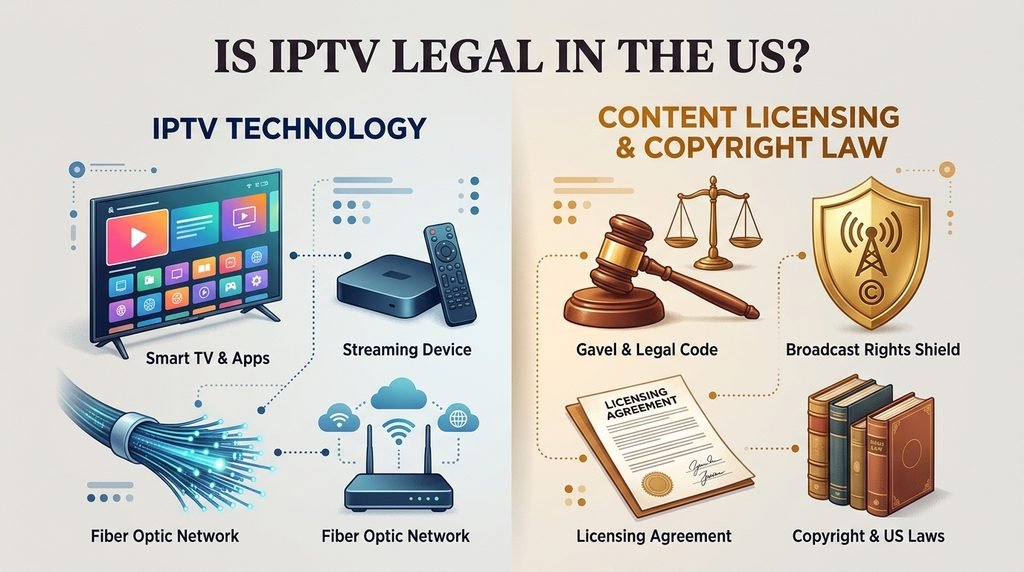
Yes. IPTV technology itself is legal in the United States. It simply describes the delivery of television and video programming through an internet connection rather than traditional cable or satellite infrastructure.
The legal question concerns the content being distributed and whether the provider has obtained permission from the relevant copyright owners.
IPTV technology vs. content distribution rights
IPTV stands for Internet Protocol Television. It allows video content to travel through internet-based networks to compatible devices, including televisions, streaming boxes, computers, tablets, and smartphones.
Many legitimate entertainment companies use internet-based distribution to deliver their programming.
For example, a licensed broadcaster can offer television programming through its own application, website, or authorized distribution partners. The delivery technology does not make the service illegal.
The important distinction is the authorization behind the content.
Consider these two hypothetical situations:
- Authorized IPTV: A provider has agreements with television broadcasters and content owners that permit it to distribute specified channels and programs to subscribers in the United States.
- Unauthorized IPTV: A provider redistributes premium television channels, movies, or live sporting events without obtaining the necessary permissions from the copyright owners.
Both services might use the same streaming technology and compatible applications. Their legal positions are different because their distribution rights are different.
This is why evaluating an IPTV provider requires more than checking its application, channel count, video quality, or subscription price.
What does US copyright law say?
The US Copyright Act establishes exclusive rights for copyright owners.
Under 17 U.S.C. §106, those rights include authorization of public performances of qualifying audiovisual works, as well as other protected uses.
Section 501 explains that violating the exclusive rights established under the Copyright Act can constitute copyright infringement. U.S. Code+1
The US Copyright Office has also explained that unauthorized streaming can infringe the copyright owner’s public-performance right when no applicable exception or limitation applies. copyright.gov+1
For an IPTV provider, this means that making protected television programming available to subscribers is not automatically authorized simply because the provider can technically access or stream it.
The relevant questions include:
- Who owns the content?
- Who authorized its distribution?
- Does the agreement cover internet streaming?
- Does the authorization include the United States?
- Does it cover live television, movies, sports, and video-on-demand content?
- Is the provider authorized to sell subscriptions or sublicense access?
A provider may have permission to distribute some content but not necessarily every channel or program in its advertised catalog.
Therefore, licensing should be evaluated according to the actual content and distribution arrangement rather than a general statement that a service is legitimate.
What the Protecting Lawful Streaming Act means
The Protecting Lawful Streaming Act of 2020 strengthened criminal enforcement against certain commercial-scale illegal streaming operations.
Signed on December 27, 2020, the legislation allows criminal penalties, including felony charges, for providers who willfully stream copyrighted material for commercial advantage or private financial gain under the applicable conditions.
The US Patent and Trademark Office explains that this provision targets providers rather than ordinary users. USPTO+1
This distinction matters because the law should not be misrepresented as making every person who watches an IPTV stream automatically guilty of a felony.
At the same time, it does not make every IPTV subscription legitimate. The source of the programming and the provider’s authorization remain important.
For consumers, the practical approach is to choose services that can explain their distribution arrangements and provide credible information about their content rights.
What Does Public Evidence Show About Xtreme HD IPTV?
Xtreme HD IPTV operates a public-facing subscription website at xtrmehdiptv.us, where visitors can review advertised packages, channel categories, supported devices, and customer support information.
However, website accessibility and the availability of subscription plans do not independently establish that the provider holds the necessary distribution rights.
What does the official website actually say?
The publicly accessible website provides several pieces of information that consumers can examine.
Its homepage advertises live television, sports, movies, and IPTV packages.
The pricing page displays subscription options and advertised channel and VOD quantities.
The channel list provides examples of programming available through the advertised packages. Its listings include recognizable broadcasters and sports networks, such as BBC, Sky Sports, Canal+, and DAZN. #1 Official IPTV in USA 2026+2
These details help consumers understand what the website is marketing.
However, a published channel list does not establish that the service has received authorization from every broadcaster represented in that list.
The About Us page also describes the company as prioritizing compliance and subscriber security. Its Terms of Service refer to local regulatory compliance and service availability. xtrmehdiptv.us+1
Those statements explain the publisher’s stated position. They are not substitutes for actual licensing documentation.
What licensing information could not be verified?
During this research, I could not independently establish the following information from the publicly inspected pages:
- A complete list of broadcasters or content owners that have authorized distribution.
- Publicly verifiable agreements covering the advertised US television channels.
- Documentation covering the redistribution of live sports and premium events.
- A documented chain of authorization for any third-party content suppliers or resellers.
- The specific geographic and content limitations of any distribution agreements.
This is an important distinction.
Not finding public licensing documentation is not the same as proving that no licensing agreement exists.
Some commercial distribution agreements are confidential. Nevertheless, a provider should be able to give customers meaningful information about its authorization without necessarily publishing commercially sensitive contract details.
There are also some public information consistency issues worth addressing.
For example, the pricing pages advertise 25,000 channels and 45,000 VOD items, while the About Us page uses different figures in its descriptions and displays zero-value counters in some sections. These figures should be standardized and supported before being presented as independently established facts. xtrmehdiptv.us+1
For a legality-focused evaluation, accurate catalog information and transparent licensing disclosures are more useful than promotional superlatives.
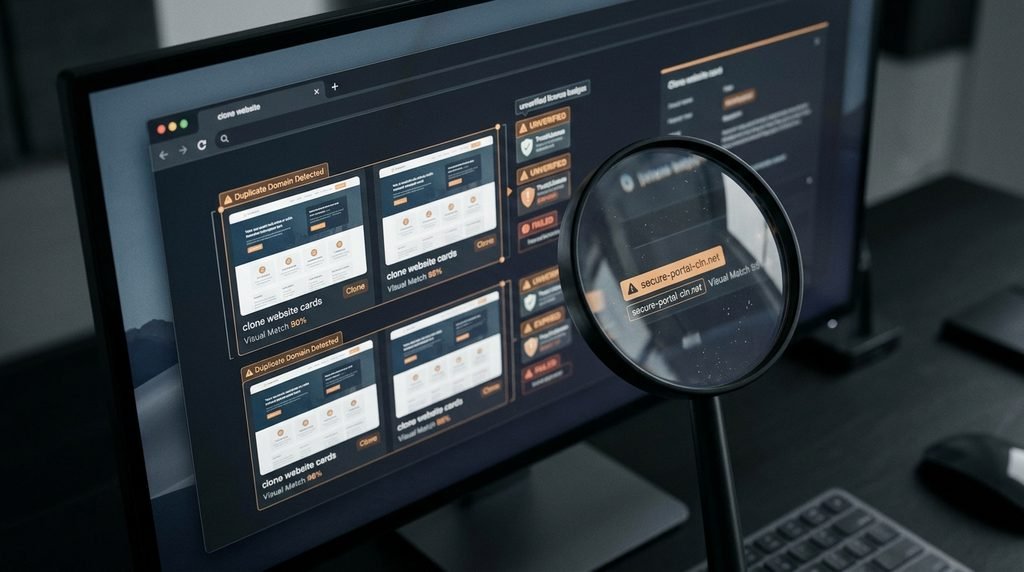
Why are there so many Xtreme HD IPTV websites?
Another issue surrounding this brand name is the presence of multiple websites using similar Xtreme HD IPTV branding.
For example, search results include:
xtremehdiptvs.ioxtremhdiptv.ioxtremehdiptv.sitextreme.ac
Some of these websites describe themselves as official destinations, while other pages discuss previous domain changes, alternative operators, or possible copycat sites. Premium IPTV Service 2026+3
These competing claims create an identity-verification problem.
A website using the same brand name, logo, or subscription description does not automatically belong to the same business.
Consumers should distinguish between three separate questions:
- Is the website genuinely operated by the seller it claims to represent?
- Is the subscription being purchased from the intended business?
- Does that business have authorization to distribute the advertised programming?
Answering one question does not automatically answer the other two.
For that reason, readers should verify the domain, legal seller identity, payment recipient, and licensing arrangements independently.
How Can You Verify an IPTV Service Before Subscribing?

The most effective way to evaluate an IPTV subscription is to examine the evidence behind its content distribution rights, rather than relying entirely on its marketing claims.
A provider should be able to explain where its programming comes from, who authorizes distribution, and whether the authorization covers customers in the United States.
IPTV Rights Verification Matrix
The following decision aid identifies the documents and information worth requesting from any IPTV provider.
ORIGINAL CONSUMER VERIFICATION CHECKLIST — RESEARCH BASIS: US COPYRIGHT RULES AND PUBLIC PROVIDER DISCLOSURES, NOVEMBER 2026
| Verification area | Strong supporting evidence | Warning sign |
|---|---|---|
| Business identity | Verifiable operating company and legal seller name | No identifiable contracting business |
| Content ownership | Named broadcasters and content rights holders | Generic claims of unlimited content |
| Distribution licenses | Written authorization or verifiable licensing arrangements | No meaningful explanation of content rights |
| Geographic coverage | Documentation covering US distribution | No clear territorial permissions |
| Reseller authorization | Verifiable authorization from the upstream distributor | Unidentified third-party content sources |
| Terms and transparency | Clear subscription, copyright and content policies | Generic legal disclaimers without meaningful disclosures |
| Payment identity | Payment recipient matches the disclosed seller | Unexplained changes in payment recipient |
This matrix is an evidence-assessment tool, not a legal certification. A company registration, business address, or payment processor alone does not demonstrate copyright authorization.
A particularly useful document is a licensing confirmation identifying the relevant rights holder, permitted content, distribution territory, and authorized distribution method.
For commercial confidentiality, a provider may supply a redacted document or an independently verifiable confirmation rather than its complete private contract.
Six questions to ask an IPTV provider
Before purchasing an IPTV subscription, ask the provider specific questions about its content rights.
1. Who supplies the television channels?
Ask whether the provider distributes content directly through agreements with broadcasters or obtains it through an authorized distributor.
A vague answer such as “we have thousands of worldwide channels” does not explain the source of the programming.
2. Are the channels licensed for US distribution?
A license covering another country does not automatically establish authorization for US subscribers.
Ask whether the relevant agreements cover the geographic territory in which you intend to watch.
3. Does the authorization include live sports and PPV?
Sports broadcasting rights can be separate from ordinary television distribution rights.
Ask whether the provider is authorized to redistribute the specific sports events and premium programming it advertises.
4. Are movies and VOD titles covered?
Movie distribution and on-demand licensing can involve different rights from live television.
A provider should be able to explain the authorization behind its advertised movie and series library.
5. Can you provide licensing information in writing?
Ask for the identity of the rights holders, the applicable territories, and evidence of the provider’s authorization.
A professional written explanation is more useful than an unsupported statement that a service is 100% legal.
6. Which company will receive my payment?
Confirm that the company accepting your payment matches the business operating the website.
Review the subscription duration, refund conditions, renewal policies, and contact information before completing a transaction.
A practical decision framework
The following framework can help you evaluate a subscription without making assumptions about its legal status.
Step 1 — Verify the seller
Confirm the exact website, business identity, support contacts, and payment recipient.
Step 2 — Identify the content sources
Determine whether the channels, movies, and sports come from broadcasters, rights holders, or authorized distributors.
Step 3 — Check the rights
Request evidence showing that distribution rights cover the content, United States territory, and relevant streaming methods.
Step 4 — Review the written terms
Examine subscription conditions, refund policies, content limitations, and copyright disclosures.
Step 5 — Make an informed decision
Verified authorization
Proceed only when the relevant rights and seller identity are sufficiently established.
Insufficient evidence
Treat the legal status as unverified and avoid committing to a subscription based on marketing claims alone.
For Xtreme HD IPTV, consumers can use the published Terms of Service and Contact Us page as starting points for requesting additional clarification.
An especially valuable improvement for the publisher would be a dedicated content-rights disclosure explaining the business’s distribution model, licensing coverage, territories, and any authorized third-party suppliers.
The bottom line: A streaming service should be evaluated based on its actual authorization, not simply its name, technical features, channel count, or subscription price.
Frequently Asked Questions About Xtreme HD IPTV Legality
1. Is Xtreme HD IPTV legal in the USA?
Its specific licensing status could not be independently confirmed from the public information reviewed. IPTV technology is legal, but providers need appropriate rights to distribute copyrighted programming. Request verifiable licensing information before subscribing.
2. Is IPTV itself illegal?
No. IPTV is a technology for delivering television over internet networks. Many legitimate broadcasters and licensed streaming platforms use it. The legal question concerns the authorization behind the content being distributed.
3. Is watching unlicensed IPTV illegal in the USA?
The legal position depends on the circumstances. US anti-piracy legislation specifically targets certain commercial streaming providers. Consumers should not assume that every streaming situation has the same legal consequences.
4. How can I verify an IPTV provider’s license?
Ask for the legal operating company, named content rights holders, licensing territories, and written evidence of distribution authorization. Check whether the documentation covers live television, sports, movies, and VOD.
5. Does a free trial prove an IPTV service is legal?
No. A free trial allows consumers to evaluate the service technically, but it does not establish that the provider has permission to distribute its content. Licensing must be verified separately.
6. Do different Xtreme HD IPTV websites represent the same company?
Not necessarily. Multiple websites use similar names and branding. Verify the exact domain, contracting business, payment recipient, and customer support details instead of assuming that similarly named websites are affiliated.
Editorial transparency: This article evaluates publicly available information and US legal documentation. It does not represent a legal opinion, independent certification, or confirmation that Xtreme HD IPTV holds or lacks particular licenses.
Next step for readers: Before subscribing, request written confirmation of the provider’s content distribution rights and verify that those rights cover US viewers.
Trust and methodology
- Publisher: Xtreme HD IPTV.
- Byline: Xtreme HD IPTV Editorial Team.
- Research date: November 4, 2026.
- Research basis: Public publisher website pages, publicly accessible competitor content, US Copyright Act provisions, and US government copyright guidance.
- Evaluation criteria: Operator identity, content ownership, distribution permissions, US territory, and subscription transparency.
- Hands-on testing: No stream testing or independent licensing audit was performed for this article.
- Legal review: No attorney review is claimed.
Next-step block
The article should conclude with a non-promotional action that directly serves the searcher’s question.
Recommended publishing CTA:
Before choosing an IPTV subscription, verify the Provider’s distribution rights ( https://xtrmehdiptv.us ), confirm its operating identity, and review its terms. A transparent provider should be able to explain where its content comes from and what authorization covers its service.