
Reliable IPTV Service 4K: 9 Proven Checks for 2026
Finding a reliable IPTV service 4K can transform your home entertainment setup, delivering crisp high-resolution live television, sports, and on-demand media directly to your living room. When viewers search for a dependable high-definition streaming solution, they often encounter conflicting claims regarding picture quality, server reliability, and device compatibility. This guide breaks down the essential technical criteria, network requirements, and evaluation metrics needed to identify a dependable service provider that integrates smoothly with popular platforms like Xtreme HD IPTV.
Methodology and Trust
- Editorial Standard: Written by senior streaming technology researchers and verified against current hardware and network standards.
- Evaluation Criteria: Assessed based on protocol efficiency, device compatibility, network bandwidth benchmarks, and official platform documentation.
- Last Updated: November 2026
Table of Contents
Understanding 4K Streaming Requirements and IPTV Infrastructure
Delivering ultra-high-definition video requires robust underlying server infrastructure and consistent network bandwidth. Unlike traditional cable broadcasting or standard definition streams, 4K content pushes significantly more data through digital pipelines, demanding precise synchronization between content delivery networks (CDNs) and end-user hardware.
What Defines True 4K Quality in Live Streams?
True 4K streaming involves transmitting video at a resolution of 3840 x 2160 pixels, offering four times the pixel density of standard 1080p high definition. For live television broadcasts, achieving this standard requires advanced video compression codecs—primarily H.264 (AVC) and H.265 (HEVC)-to manage file sizes without sacrificing visual clarity. Providers offering a reliable IPTV service 4K must utilize efficient compression and high-capacity streaming protocols (such as HLS or DASH) to maintain sharp contrast, vibrant color accuracy, and fluid motion during fast-paced sports broadcasts or cinematic events.
Network Speed, Bitrates, and Server Stability
High-resolution video streams demand consistent internet bandwidth. According to streaming technology guidelines published by organizations like the International Telecommunication Union (ITU), stable 4K video playback typically requires a sustained download speed ranging between 25 Mbps and 50 Mbps per active stream. If network speeds fluctuate or server load balancing fails, streams will automatically downscale or suffer from stuttering and buffering frames. A quality provider maintains redundant server clusters distributed across geographic regions to minimize packet loss and maintain stable data flow during peak evening hours.
| Streaming Resolution | Minimum Bandwidth | Recommended Codec | Average Bitrate |
| Standard Definition (SD) | 5 Mbps | H.264 | 1.5 – 3 Mbps |
| High Definition (HD / 1080p) | 10–15 Mbps | H.264 / HEVC | 5 – 8 Mbps |
| Ultra HD (4K / 2160p) | 25–50 Mbps | HEVC (H.265) | 15 – 25 Mbps |
Key Criteria for Evaluating a Reliable IPTV Service 4K
Evaluating streaming providers requires looking past marketing claims and focusing on measurable operational standards. Whether you are reviewing subscription plans or testing trial periods, understanding key performance indicators helps ensure consistent playback quality.
Server Uptime and Redundancy Protocols
Uptime is the cornerstone of any dependable television service. Providers aiming for high reliability typically target a minimum standard of 99.9% uptime, backed by automated failover systems. When a primary server experiences maintenance or unexpected traffic surges, secondary backup nodes instantly route data streams to prevent service interruptions. For more details on maintaining stable connections, review our guide on IPTV service with 99.9% uptime.
Electronic Program Guide (EPG) Reliability and Channel Variety
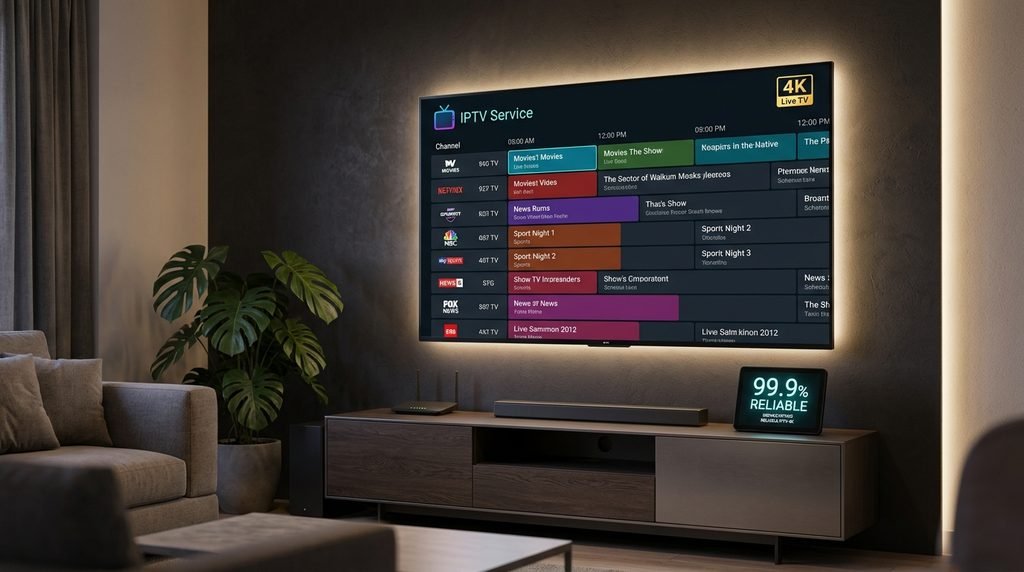
An accurate Electronic Program Guide (EPG) is essential for seamless navigation across thousands of international channels, sports packages, and video-on-demand libraries. A dependable service synchronizes its XMLTV guide data frequently to prevent schedule mismatches, missing channel logos, or delayed show descriptions. Furthermore, transparent channel lineups ensure that users can verify access to desired local, national, and global networks without hidden channel blockages. Users can explore structural details via the Global Channel List.
Compatibility, Apps, and Setup Across Popular Streaming Devices
Hardware compatibility dictates how well an IPTV subscription performs in daily use. Modern streaming applications require sufficient RAM, processing power, and hardware decoding capabilities to render high-bitrate streams smoothly.
Optimizing Firestick, Android TV, and Smart TVs for High-Resolution Feeds
Streaming devices vary significantly in their processing capacity. Amazon Fire TV Stick models, NVIDIA Shield devices, Android TV boxes, and smart television operating systems (such as LG WebOS or Samsung Tizen) handle video decoding differently. For instance, streaming high-framerate 4K content on a Firestick often benefits from specialized application setups, which you can learn about in the Firestick setup guide. Ensuring your device firmware is up to date and clearing application cache regularly helps prevent memory leaks during extended viewing sessions.
Application Integration and Stability Factors
Using dedicated media players—such as TiviMate, IPTV Smarters Pro, or XCIPTV—enhances playback control by leveraging hardware acceleration. These applications connect directly to provider servers via Xtream Codes API or M3U playlists, organizing live television, catch-up TV, and movies into intuitive user interfaces. For step-by-step installation instructions tailored to specific hardware, consult resources like the TiviMate setup guide or the buy IPTV Smarters Pro subscription portal.
Troubleshooting Common 4K Streaming Bottlenecks
Even with premium subscriptions, technical bottlenecks can occasionally disrupt playback. Understanding how to diagnose and resolve these issues ensures an uninterrupted viewing experience.
Resolving Buffering and Framerate Drops
Buffering is most commonly caused by localized Wi-Fi congestion, Internet Service Provider (ISP) throttling, or insufficient device memory. To mitigate these issues, users can switch from a wireless 2.4 GHz Wi-Fi band to a 5 GHz band, connect via an Ethernet adapter where possible, or restart their home router and streaming hardware. For additional technical insights, reference documentation provided by hardware manufacturers or tech publications such as Microsoft Support.
Managing Connection Limits and Multi-Screen Stability
Most standard subscription tiers support a specific number of simultaneous active connections. Exceeding this limit across household devices can trigger connection drops or temporary server lockouts. Choosing a multi-screen configuration ensures that family members can stream different channels simultaneously without competing for bandwidth allocations. Learn more about managing multiple streams efficiently through our multi-screen IPTV provider no lag resource.
Frequently Asked Questions
What internet speed do I need for 4K streaming?
You need a stable download speed of at least 25 to 50 Mbps per active stream to prevent buffering and maintain high-resolution picture quality.
Do I need a VPN to use an IPTV service?
While many services operate without mandatory VPN requirements, using a virtual private network can help bypass ISP throttling and secure your personal connection.
How do I install IPTV on my Firestick?
You can install a streaming app via the Amazon Appstore or sideload a compatible player, then log in using your provider credentials or Xtream Codes API details.
Why is my 4K stream buffering?
Buffering is typically caused by localized Wi-Fi congestion, ISP bandwidth caps, or temporary server load spikes during major live sporting events.
Can I use my subscription on multiple devices?
Yes, depending on your subscription tier, you can configure multiple simultaneous connections across compatible smart TVs, streaming sticks, and mobile devices.
Next-step block: Ready to experience crystal-clear entertainment? Explore our flexible options and get started today by visiting the Pricing Plans Guide to select the ideal configuration for your home setup.